
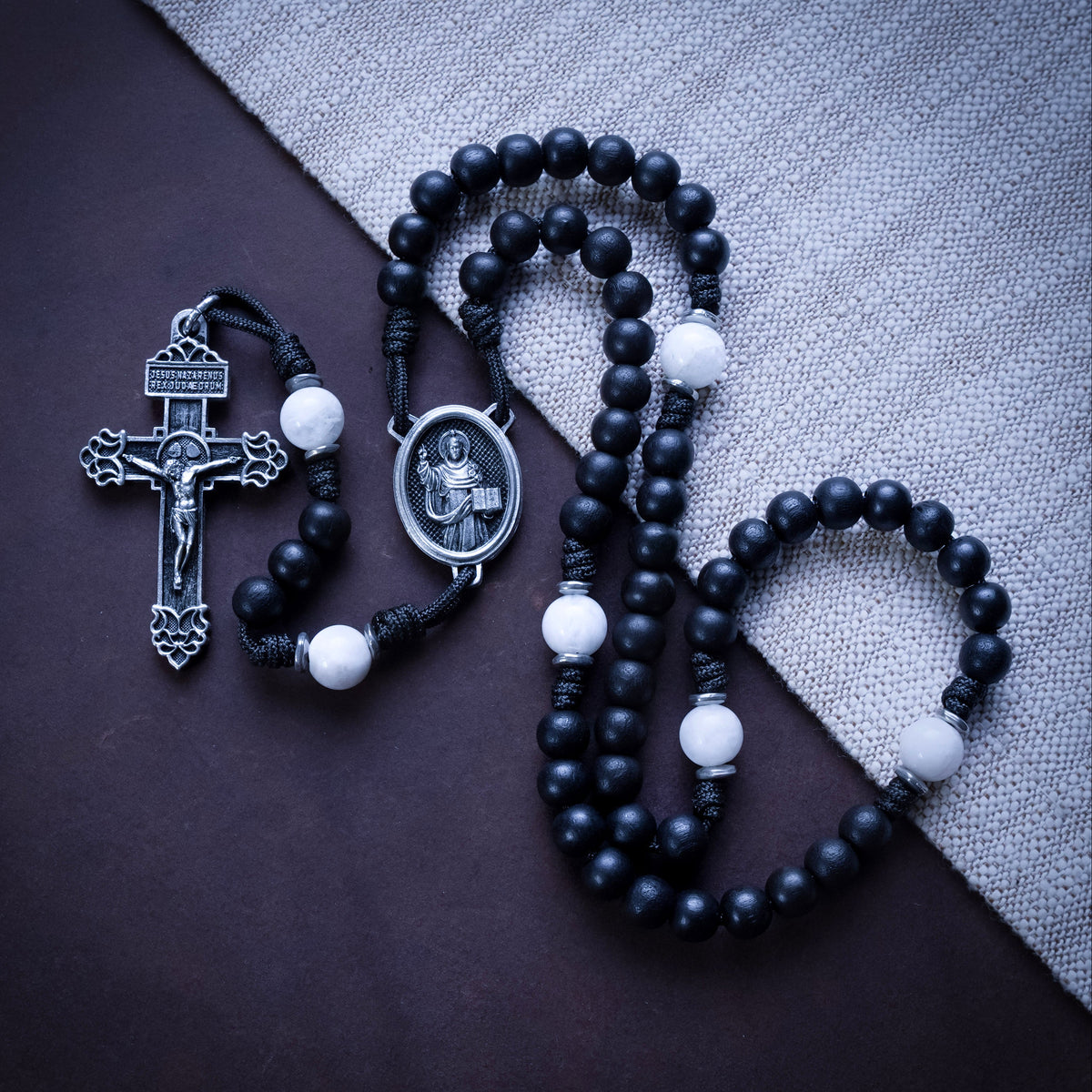
St. Dominic and the Rosary
Discover the history of St. Dominic and the rosary — how a 13th-century Spanish friar received this powerful prayer in a vision, founded an Order to spread it, and why Catholics still pray it today.
For over eight centuries, Catholics have turned to the rosary as a weapon of prayer, a meditation on the Gospel, and a lifeline to the Blessed Virgin Mary. That tradition begins with St. Dominic — a Spanish friar who, according to Dominican tradition, received the rosary in a vision and unleashed it on heresy, changing the Church forever.
Quick Reference| Topic | Key Fact | Significance |
|---|---|---|
| St. Dominic | Born 1170, Caleruega, Spain | Founder of the Dominican Order; according to tradition, received the rosary in a Marian vision |
| Dominican Order | Founded 1216, approved by Pope Honorius III | Preserved and spread the rosary across Europe and beyond |
| Albigensian Heresy | 11th–13th century dualist heresy | The crisis that prompted Dominic's mission and the rosary's origin |
| Marian Psalter | 150 Hail Marys in decades of 10 | The original structure of the rosary, traditionally given to St. Dominic |
| Four Sets of Mysteries | Joyful, Sorrowful, Glorious, Luminous | Meditations on the key moments of Christ's life and Mary's role |
| Luminous Mysteries | Added by Pope St. John Paul II, 2002 | Highlight Jesus' public ministry — Baptism, Cana, Transfiguration, Eucharist |
Who Was St. Dominic?
St. Dominic was born in 1170 in Caleruega, Spain, into a noble family. From his earliest years he displayed a profound commitment to prayer, study, and the pursuit of truth. After studying theology, he became a canon at the Cathedral of Osma — and it was there that his vocation as a preacher began to take shape.
Early Life and Mission
When Dominic encountered the Albigensian heresy sweeping through southern France, he recognized an urgent need: not just for sermons, but for prayer rooted in the mysteries of Christ. He understood that the best response to doctrinal error was a deep, meditating faith. This insight — that intellectual rigor and spiritual devotion must go hand in hand — would define his entire ministry and lead directly to the rosary.
The Dominican Order
In 1216, St. Dominic founded the Order of Preachers — the Dominicans — formally recognized by Pope Honorius III. Unlike cloistered monks, Dominican friars were active preachers, teachers, and missionaries. Their commitment to the rosary, which Dominic had championed, became central to their identity and helped spread this devotion across the entire Catholic world.
St. Dominic didn't just preach against heresy — he gave the Church a tool for prayer that refocused Catholics on the central mysteries of the Gospel. The Dominican Order carried that gift forward for centuries.
| Period | Event | Significance |
|---|---|---|
| 1170 | Born in Caleruega, Spain | Noble family; early religious formation shapes his future |
| c. 1203 | Encounters Albigensian heresy in France | Triggers mission of preaching and prayer |
| c. 1208 | Vision of Our Lady near Toulouse (Dominican tradition) | Traditionally, this is when he received the rosary as a weapon against heresy |
| 1216 | Founds Order of Preachers | Approved by Pope Honorius III; Dominicans spread the rosary worldwide |
| 1221 | Death of St. Dominic | Dominican Order continues his rosary mission |
How St. Dominic Received the Rosary
Between the 11th and 13th centuries, a heretical doctrine called Albigensianism spread across Europe. Its followers held a dualist view of reality: a good God created the spiritual world, while an evil god created the material world. This meant the body was evil, the soul was trapped, and salvation required the soul's escape from matter — a direct attack on the Incarnation of Jesus Christ.
In the early 1200s, St. Dominic traveled to France to preach against this heresy but saw little fruit. He went into a forest near Toulouse to pray, asking God for the tools he needed. According to Dominican tradition, it was there that he received a vision of the Blessed Virgin Mary, who presented him with the rosary as a powerful weapon against heresy and a means of drawing souls back to Christ.
The mysteries of the rosary — Incarnation, Passion, Resurrection — are a direct refutation of Albigensian dualism. They declare that the body matters, that Christ truly became flesh, truly suffered, and truly rose. Meditating on these truths was itself an act of doctrinal faithfulness.
The Marian Psalter
According to that tradition, Our Lady revealed that Dominic must preach her psalter — praying the Hail Mary 150 times (echoing the 150 Psalms), grouped in decades of 10, each separated by an Our Father. She also revealed which mysteries of Christ's life should be meditated upon with each set of prayers. This structure, the Marian Psalter, is the direct ancestor of the rosary Catholics pray today.
The rosary was given not as a devotional novelty but as a theological weapon — a structured meditation on the very truths Albigensianism denied. Each Hail Mary is an affirmation that Christ was truly born of a woman, truly human, truly God.
| Element | Structure | Meaning |
|---|---|---|
| Hail Mary | 150 times total (10 per decade) | Honors Mary, Mother of God; echoes the 150 Psalms |
| Our Father | Once per decade (15 total) | The prayer Christ taught; frames each mystery in direct petition to the Father |
| Mysteries | Meditated during each decade | Stories of Christ's life that refute dualist heresy; anchor prayer in the Gospel |
| Apostles' Creed | Opening prayer | Profession of faith; sets the theological foundation for the entire rosary |
Why the Dominicans Promoted the Rosary
After St. Dominic's death in 1221, the Dominican Order continued his work with remarkable consistency. The rosary was not merely a pious practice for Dominicans — it was core to their mission of preaching the Gospel and combating error. Dominican friars taught laypeople how to pray it, wove it into their own liturgical life, and carried it on missions across Europe, Africa, Asia, and the Americas.
The emphasis was never merely on repetition. Dominican teaching stressed meditation on the mysteries — the active contemplation of Christ's life, death, and resurrection — as the heart of rosary prayer. The beads were a counting tool; the real work was interior, forming the soul to think with the Church.
The rosary is sometimes dismissed as "vain repetition." Dominican spirituality answers this directly: the repetition of the Hail Mary is not mindless — it is a rhythm that frees the mind to meditate, the way a repeated breath frees a musician to think about the music, not the mechanics of breathing.
The Dominicans gave the rosary its structure, theology, and global reach. Without the Order of Preachers, this devotion might have faded into a regional practice. Instead, it became the universal prayer of the Catholic Church.
The Rosary as a Weapon of Spiritual Battle
St. Dominic understood that the rosary was more than a devotional exercise — it was a form of spiritual combat. By meditating on the life of Christ, Catholics armor themselves against the temptations, lies, and distractions that pull them from God. The repetition of prayer is not rote — it is the repeated action of bringing the mind back to what is true.
The Hail Mary
Also known as the Ave Maria, the Hail Mary honors the Blessed Virgin Mary, the Mother of God, and asks for her intercession "now and at the hour of our death." Central to the rosary, it invites the faithful to see the life of Christ through Mary's eyes — the woman who said yes to God and whose entire life pointed to her Son.
The Our Father
Prayed once per decade, the Our Father — or Pater Noster — is the prayer Christ himself taught his disciples. It orients the faithful toward the Father: acknowledging His holiness, submitting to His will, asking for daily provision and protection. Prayed at the start of each mystery, it frames every meditation in explicit dependence on God.
The rosary is a weapon forged for spiritual warfare. Through Mary's intercession and meditation on Christ's mysteries, Catholics find protection from sin, clarity in trial, and strength to persevere in faith.
| Prayer | Position in Rosary | Spiritual Function |
|---|---|---|
| Apostles' Creed | Opening | Grounds prayer in doctrinal faith; counters heresy and doubt |
| Our Father | Once per decade | Submission to God's will; petition for protection and provision |
| Hail Mary | 10× per decade | Invokes Mary's intercession; meditates on Christ's life through her eyes |
| Glory Be | End of each decade | Doxology; orients the soul toward the Trinity in praise |
| Fatima Prayer | Optional, after Glory Be | Petition for souls in purgatory; given by Our Lady at Fatima, 1917 |
Meditating on the Key Moments in the Gospel
The mysteries of the rosary are not abstract theological concepts — they are the story of salvation, told in the specific events of Jesus Christ's life. Meditating on them draws the faithful into that story, making them participants in redemption rather than distant observers.
The Joyful Mysteries
Prayed on Mondays and Saturdays, the Joyful Mysteries guide us through the Annunciation, the Visitation, the Nativity, the Presentation in the Temple, and the Finding of Jesus in the Temple. These are the events of the Incarnation — God becoming flesh, dwelling among us, beginning His earthly mission through the "yes" of the Virgin Mary.
The Sorrowful Mysteries
Prayed on Tuesdays and Fridays, the Sorrowful Mysteries focus on Christ's Passion: the Agony in the Garden, the Scourging, the Crowning with Thorns, the Carrying of the Cross, and the Crucifixion. Meditating on these events is a confrontation with the price of salvation — not as guilt, but as an invitation into the depth of God's love.
The Glorious Mysteries
Prayed on Wednesdays and Sundays, the Glorious Mysteries celebrate Christ's Resurrection, the Ascension, Pentecost, the Assumption of Mary, and her Coronation as Queen of Heaven. These are mysteries of hope — the promise that death is not the end, and that those who follow Christ will share in His glory.
The Luminous Mysteries
Added by Pope St. John Paul II in 2002 and prayed on Thursdays, the Luminous Mysteries illuminate Jesus' public ministry: His Baptism in the Jordan, the Wedding at Cana, the Proclamation of the Kingdom, the Transfiguration, and the Institution of the Eucharist. These mysteries bridge the Joyful and Sorrowful, showing the full arc of Christ's mission.
The four sets of mysteries turn the rosary into a complete journey through the Gospel. Each week, the faithful walk with Christ from His Incarnation through His Passion to His Resurrection — and are invited to follow Him to glory.
| Set of Mysteries | Day Prayed | Events Covered | Central Theme |
|---|---|---|---|
| Joyful | Mon / Sat | Annunciation, Visitation, Nativity, Presentation, Finding in Temple | The Incarnation — God becoming flesh |
| Sorrowful | Tue / Fri | Agony, Scourging, Crowning, Carrying the Cross, Crucifixion | The Passion — the price of salvation |
| Glorious | Wed / Sun | Resurrection, Ascension, Pentecost, Assumption, Coronation | The Resurrection — promise of eternal life |
| Luminous | Thu | Baptism, Cana, Kingdom Proclamation, Transfiguration, Eucharist | Christ's public ministry — light of the world |
Why the Rosary Is Still Relevant Today
Eight hundred years after St. Dominic received the rosary, Catholics still pray it daily — in homes, parishes, hospitals, prisons, and in the pews before Mass. Its relevance has not diminished. If anything, in an age of relentless distraction and digital noise, its call to quiet contemplation has become more urgent, not less.
A Simple Tool for Spiritual Growth
The rosary's power lies in its simplicity. No theological expertise is required — only a willingness to bring the mind back, decade by decade, to the life of Christ. Through that repetition, souls are formed. Virtues are cultivated. Distractions are quieted. The rosary does not demand much to begin; it transforms those who persist.
Connecting Catholics to Tradition
When a Catholic prays the rosary today, they pray in communion with every Dominican friar, every medieval peasant, every Marian apparition recipient, and every soldier, prisoner, and saint who clutched the beads before them. The rosary is a thread running through Catholic history — tangible, tactile, unbroken.
Honoring Mary and Seeking Her Intercession
The rosary is also a Marian prayer — an act of honoring the woman who said "yes" to God at the Annunciation and who stood at the foot of the Cross. Through it, Catholics ask for her intercession: not to replace Christ, but to approach Him through the one who knew Him best, who bore Him, who followed Him all the way to death and beyond.
Many saints recommend committing to one decade of the rosary daily before attempting the full five. St. Louis de Montfort, a great Dominican-influenced preacher, wrote that even an imperfect rosary prayed faithfully is infinitely more valuable than a perfect rosary never started.
The rosary thrives not despite modernity but because of it. In a fragmented, distracted world, a daily practice that demands slow, meditative, intentional prayer is countercultural in the best possible way.
Introducing the St. Dominic Rosary
 The St. Dominic Rosary — designed with the Godsplaining friars for serious devotion
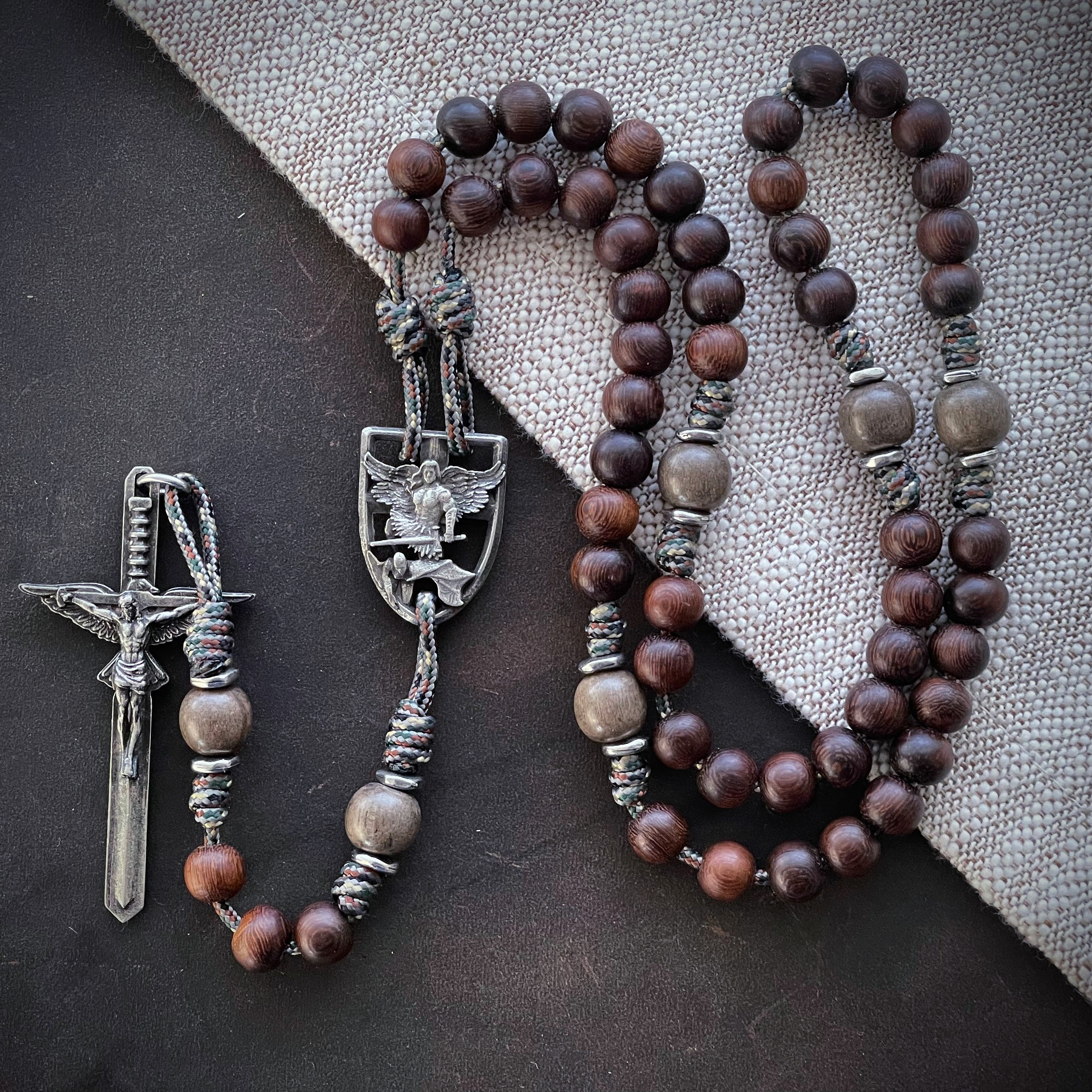
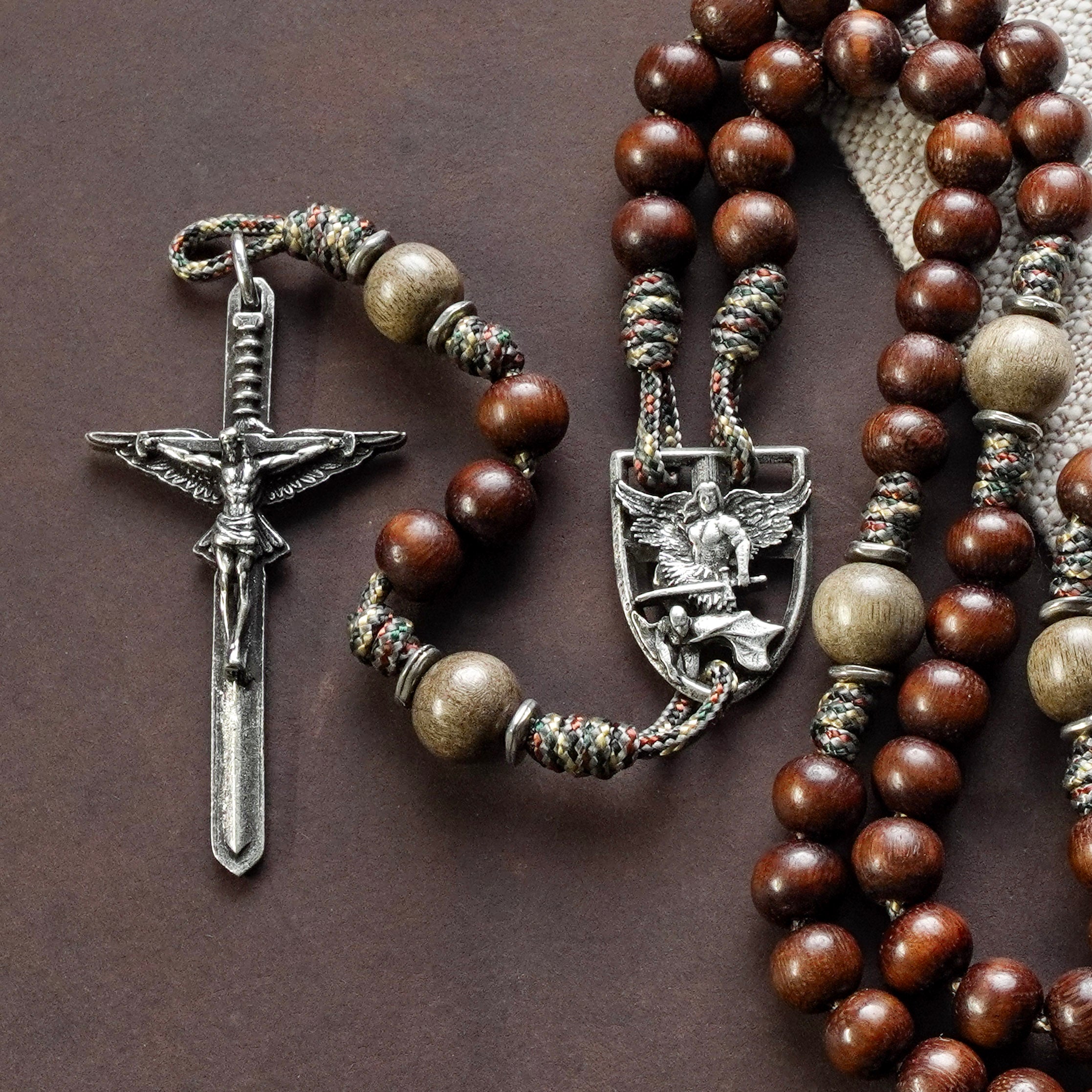
The Catholic Woodworker is proud to offer the St. Dominic Rosary, designed in collaboration with the Dominican friars of the Godsplaining Podcast. This is not a generic rosary with a saint's name attached — it is a purpose-built tool of Dominican devotion.
What Makes It Different
Unlike a traditional rosary centered on a Marian medallion, the St. Dominic Rosary features an image of St. Dominic himself at its center — a constant reminder of the man who, according to tradition, received this devotion from Our Lady, founded an Order to spread it, and gave his life to the mission of bringing souls to Christ. Every decade prayed on this rosary connects you to that 800-year tradition.
Designed for Serious Devotion
Crafted with durable materials and the attention to detail The Catholic Woodworker is known for, the St. Dominic Rosary is built to be prayed daily, carried on missions, passed down through families. It is especially meaningful for those seeking St. Dominic's intercession — students, preachers, those battling intellectual doubt or spiritual dryness.
This rosary connects you not just to a prayer but to a living tradition — eight centuries of Dominican preaching, prayer, and mission. Carry the legacy of St. Dominic in your hands.
Final Thoughts
The rosary is one of the Catholic Church's great gifts — a prayer born from a vision, sharpened by theological necessity, and spread by a band of mendicant preachers who believed the world could be changed one decade at a time. St. Dominic didn't invent the Hail Mary or the Our Father. He received a structure, a mission, and a tool — and he used it with everything he had.
Catholics who pray the rosary today stand in a long line that stretches from a forest near Toulouse in the early 13th century, through the Dominican missions of every continent, and into the living rooms, pews, and hospital rooms where the beads are still held today. The rosary is not nostalgic. It is alive.
If you're called to deepen your rosary practice — or to begin one — the St. Dominic Rosary is designed for exactly that journey. Crafted for serious prayer. Rooted in Dominican spirituality. Ready to be prayed.
Q&A Flashcards: St. Dominic & the Rosary
Tap any card to reveal the answer.